
Pi Day Math Activities: Bringing Fun to the Classroom
Have you ever mentioned Pi Day and suddenly your students are more interested in math than they were five minutes earlier? Maybe it’s the promise of pie, the strange number that never ends, or simply having something different to celebrate. Whatever the reason, March 14 gives us a perfect excuse to shake up our usual math routine. Pi Day Math can get our students measuring, investigating, creating, and even competing while still building meaningful math connections. Sometimes, seeing math differently is exactly what our student who insists, “Math is too hard,” need.

Why Pi Day Math Is Worth Celebrating
One of my favorite things about Pi Day is that it gives our students permission to explore math differently. We aren’t limited to equations on a worksheet or another day of repetitive practice. Our students can measure, build, graph, investigate, write, and make discoveries. Those experiences can help them see that math is much more than calculating an answer.
Of course, Pi Day Math should still have a purpose. Pi represents the relationship between a circle’s circumference and diameter, so circles give us plenty to investigate. Our students can explore that relationship themselves instead of simply memorizing the number 3.14.
You also don’t have to squeeze every possible Pi Day activity into one class period. Choose activities that make sense for your students, available time, and current math skills. Your younger students might focus more on vocabulary and creative activities, while older students can tackle deeper investigations. The goal is to give your students a chance to experience math in a new way.
Introduce Pi Day Math Through Circles
Before jumping into all the Pi Day fun, make sure your students understand what makes pi so interesting. No matter how large or small the circle becomes, the relationship between the diameter and circumference stays the same.
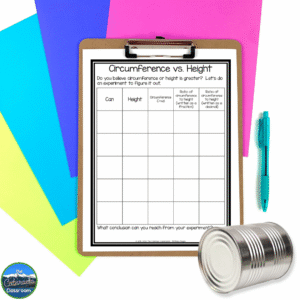
One way to do this is with my Circumference vs. Height activity from my Pi Day Math Activities Bundle. Your students will use different-sized cans and measure both the circumference and height of each one. They record those measurements before comparing the circumference to the height. This gets them measuring, calculating ratios, and looking for relationships between their results.
You can make the investigation even deeper by asking your students to predict what they expect before they begin. Once everyone has collected their measurements, bring your class back together to compare results. Ask which cans produced similar ratios and what differences they noticed between the cans. This helps your students to use their results to look for math patterns.
Get Creative with Pi Day Math Crafts
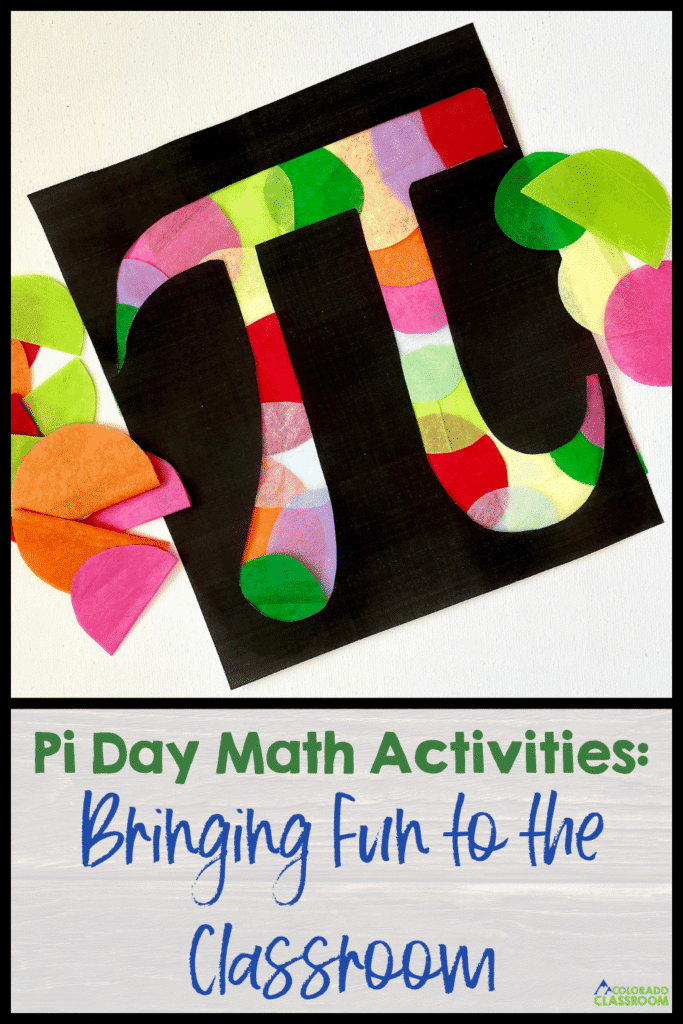
For your younger students, Pi Day Math can include plenty of creativity alongside the numbers. Crafts give your students another way to interact with circles and the digits of pi. You can use them after introducing pi or as part of a larger Pi Day rotation. They also work well when you want your students doing something hands-on during the celebration.
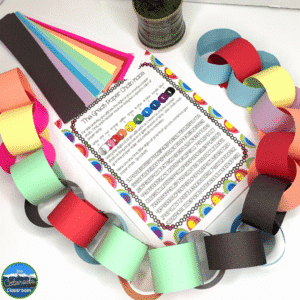
Before your students begin, decide which craft you want everyone to complete and gather the materials at each table. If your students are using the digits of pi, display the sequence somewhere everyone can easily see it. Model the first several steps together so your students understand how the math pattern connects to their project. Then let them continue independently while you circulate and help as needed.
I recommend assigning a different color to each digit from zero through nine. Your students can use that key to turn the digits of pi into a repeating sequence of colors. Depending on the activity, they might work with beads, paper, or other craft materials. Remind them to follow the digits in order so their finished project represents pi rather than a random pattern.
My Pi Day Math craft activities give you several options, so you don’t need to complete every project. Choose one that fits your students, available time, and the materials you already have. You could also place a craft at one station while other groups complete math investigations. That keeps the activity manageable while still giving your younger students a creative way to celebrate Pi Day.
Turn the Digits of Pi into Pi Day Math Activities
The digits of pi give you another fun way to bring Pi Day Math into your classroom. This activity will let them do something with those digits. Graphing gives your students an opportunity to organize the numbers and look at them differently.
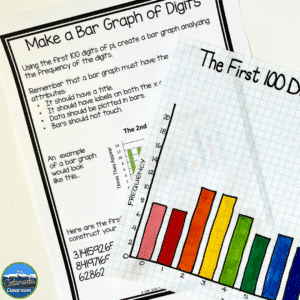
Before beginning the graphing activity, review the parts of a bar graph your students will need. Then give them the digits of pi they’ll be analyzing and have them tally how often each digit appears. I would model counting one or two digits first so everyone understands the process. Once their tallies are complete, students can transfer those totals to their graphs.
My Make a Bar Graph of Digits activity in my Pi Day Math Activities Bundle provides the graph your students need for the activity. Once their graphs are complete, don’t stop at the finished picture. Ask which digit appeared most, which appeared least, and whether anything surprised them. You can also have your students compare their observations with a partner before discussing them as a class.
You can take the digits of pi beyond traditional math practice, too. My bonus activities challenge your students to memorize pi, create a poem based on its digits, and even use the digits to make music. These give your students several ways to interact with the same famous number.
Use Pi Day Math to Explore Geometry
Pi Day is also a great time to explore the parts of a circle. You and your students can work with vocabulary like radius, diameter, circumference, chord, arc, and tangent. You’ll want to give your students chances to identify them within circles. This keeps the vocabulary connected to the geometry your students are learning.
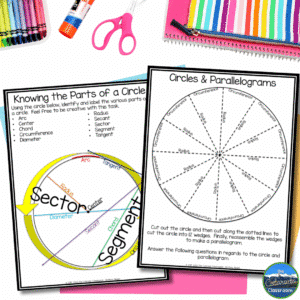
The Knowing the Parts of a Circle activity in my Pi Day Math Activities Bundle gives your students practice with this vocabulary. They will identify different parts of a circle using the provided diagrams. I recommend completing the first few together before having your students continue independently. This gives you an opportunity to catch confusion between commonly mixed-up terms before your students move on.
You can also use the Circles & Parallelograms activity to take your Pi Day Math exploration further. In this activity, your students will cut a circle into sections and rearrange the pieces into a shape resembling a parallelogram. They then use the rearranged pieces to explore how the area of a circle relates to the area of a parallelogram. This gives your students a visual way to work with the math instead of only seeing a formula on the board.
Pi Day activities like these can make geometry feel much more approachable. Your students aren’t only labeling diagrams or plugging numbers into formulas. They’re cutting, rearranging, identifying, and looking for math connections. That hands-on element can make Pi Day a great opportunity to reinforce concepts your students have already started learning.
Even Your Older Students Can Investigate Pi Day Math
Your older students can take Pi Day Math beyond basic circle measurements and into inquiry. This is their chance to make predictions, conduct experiments, and wonder why something happened. Think of all the fun the science teachers in your school buildings get to have with labs. Now it’s our turn, but just without the frog guts!
My Moebius Strips activity is one way to get your students wondering what will happen next. Your students will use long strips of paper, tape, scissors, and colored pencils or markers to complete the investigation. Before each step, you want to encourage your students to predict what they think will happen when the strip is changed or cut. Then they can compare those predictions with what actually happens.
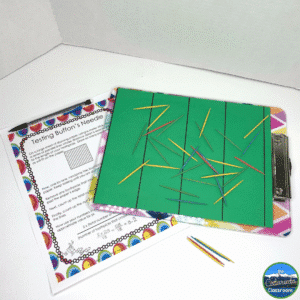
You can take the inquiry even further with Testing Buffon’s Needle. For this activity, you will place your students into groups. The groups will use large drawing paper, meter sticks, a marker, and 50 toothpicks. Throughout this activity, your students will complete repeated trials and use the results to explore the surprising math connection behind the experiment.
My Inquiry Activities resource also gives you options like Voluminous Tubes, Pi Day Logic, Exploring Circumference & Diameter, and Constructing Circles with 3 Points. You don’t need to use every investigation in one day. Choose one or two that fit your students, or save several for stations. That way, your Pi Day Math celebration gives your students time to actually investigate instead of racing from activity to activity.
Add Some Friendly Competition to Pi Day Math
Not every activity has to become a full investigation. Sometimes a quick challenge is exactly what you need to keep the energy going. A little friendly competition can also pull in your students who aren’t immediately excited about measuring another circle.
One option from the bonus activities is Simon Pis. This activity is a memory game based on the digits of pi. Begin with 3 and have your students repeat the number back to you. Continue adding one digit at a time as your students repeat the entire sequence. Your students are eliminated when they make a mistake, and the last student remaining wins the challenge.
You can also try the Memorize Pi challenge. Give your students time to study the digits of pi before seeing how many they can correctly recite. The resource even includes certificates for recognizing the winners of these challenges. It is an easy addition when you want something fun without setting up another full math investigation.
These lighter activities don’t need to carry the entire Pi Day lesson. Pair them with your measurement, geometry, or inquiry activities so your students experience several sides of Pi Day Math. They can investigate important math ideas and still enjoy the novelty of celebrating March 14.
Organize Your Pi Day Math Activities into Stations
If you’re looking at all these ideas and wondering how you’re supposed to fit them into one Pi Day, stations are your friend. Instead of choosing one whole-class activity, set up several experiences around the room. Small groups can rotate between measurement, graphing, geometry, vocabulary, and inquiry activities.

Keep your stations manageable by deciding how long your students will spend at each one before you begin. Place all needed materials at each station and give your students clear directions for recording their work. You can also mix independent stations with more involved activities that need your support. That keeps you from trying to supervise five complicated experiments simultaneously.
I’ve used this approach with my own teammates to create a much larger Pi Day experience. You can read exactly how we organized it in my Pi Day Station Rotations post. It’s especially helpful if you want your students to experience several activities instead of spending the entire celebration on one.
Make Pi Day Math Work for Your Students
There isn’t one right way to celebrate Pi Day. You can spend an entire afternoon rotating through activities or choose one investigation for your regular math period. What matters is giving your students opportunities to explore, ask questions, and make connections. That’s what makes Pi Day Math so much fun. Your students who usually picture math as numbers, equations, and worksheets get to experience another side of it. They’re measuring, predicting, graphing, creating, investigating, and asking questions. If they leave class thinking math was a little cooler than they thought that morning, I’d call that a pretty successful Pi Day!
Find More Math Resources for Your Classroom
Pi Day gives us a fun excuse to shake up our usual routines, but engaging math doesn’t have to stop on March 14. Look for opportunities throughout the year to let your students practice skills in different ways. Games, hands-on activities, visual supports, and meaningful practice can all help make familiar concepts feel fresh.
If you’re looking for more ways to bring that variety into your classroom, visit my TPT store for additional math resources. You’ll find activities for graphing, probability, order of operations, reference sheets, and many other math resources. They can all help you add engaging practice without having to create something new every time your students need reinforcement.
Take a look through the store and choose resources that match the skills your students are currently learning or need to review. You can use them for whole-class lessons, independent practice, stations, review days, or extra reinforcement. Whether you’re planning Pi Day Math or simply trying to make Tuesday’s lesson more interesting, you’ll have more options ready when you need them.
Save for Later
Save this post to your favorite math Pinterest board so these Pi Day Math activities are easy to find when Pi Day rolls around.

Pingback: 3 Pi Day Activities - The Colorado Classroom